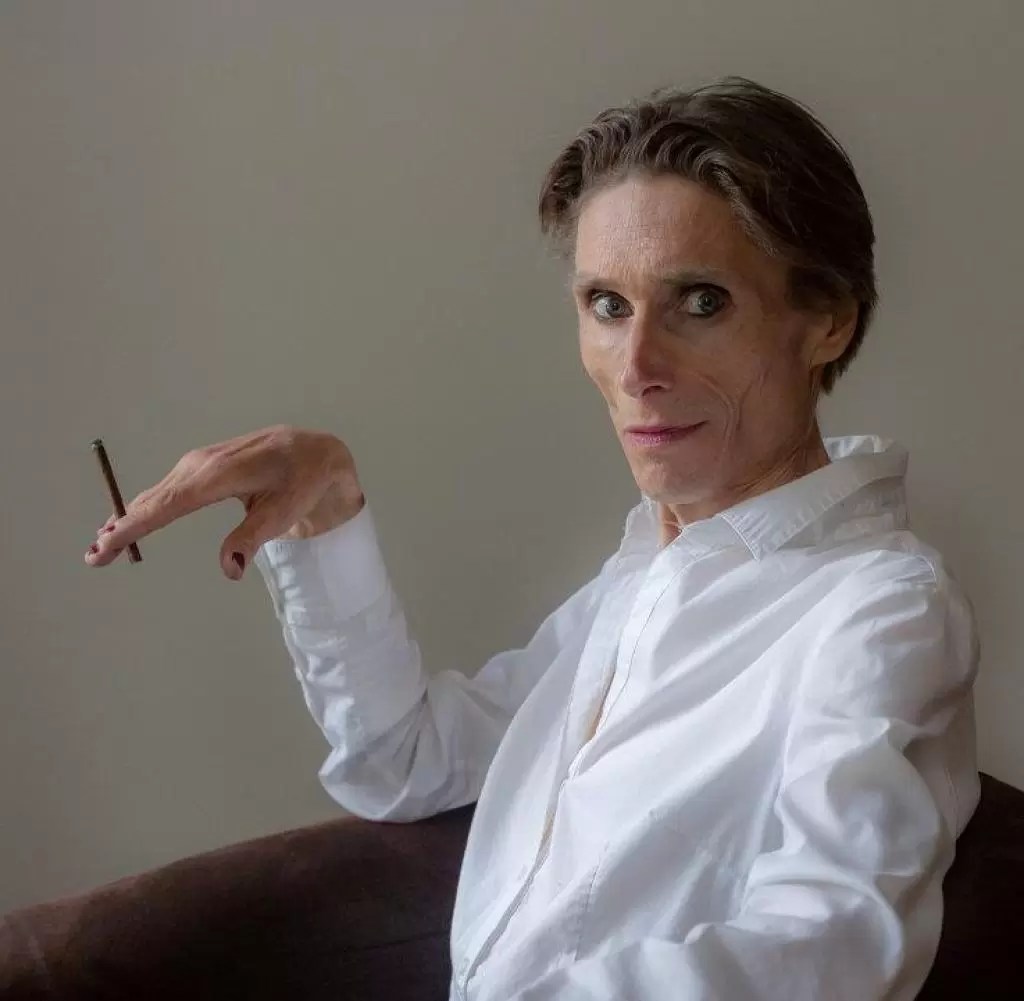
The Genesis of Reinvention: From Claus Beck-Nielsen to the "Death" of an Author
The name Madame Nielsen evokes an image of enigmatic artistry, a figure constantly shifting, challenging, and redefining the boundaries of identity. Before the persona of Madame Nielsen emerged, the artist was known as Claus Beck-Nielsen, a Danish multi-artist whose journey began in the modest surroundings of Aarhus, Tønder, Aalborg, Odense, Vestbirk, and Håstkåb. His early forays into the artistic world included a stint as a guitarist and singer in the Odense band Creme X-Treme, showcasing an early inclination towards performance and creative expression. This youthful exploration soon led him across the Atlantic, where he immersed himself in the vibrant performance art scene of New York, joining the renowned Wooster Group, known for its experimental and avant-garde approach, with notable figures like Willem Dafoe. This period undoubtedly shaped his understanding of theatricality, presence, and the power of radical artistic statements.
Upon returning to Denmark, Claus Beck-Nielsen solidified his academic foundation, earning a Master's degree in Authorship in 1993. He co-directed the theatre "Gespenst des 20. Jahrhunderts" (Ghost of the 20th Century) with Rolf Heim and contributed significantly to cultural discourse as a theatre critic for the influential newspaper Politiken from 1996 to 1999. These diverse experiences laid the groundwork for a truly unique artistic trajectory, one that would soon take a dramatic and conceptually groundbreaking turn.
The year 2001 marked a pivotal moment: Claus Beck-Nielsen, the author and multi-artist, declared himself dead. This was not a literal demise but a profound artistic statement, a performative act designed to sever ties with a fixed identity and embrace a fluid, evolving existence. To manage and produce the ongoing work of this "deceased" artist, an entity known as "Das Beckwerk" was founded in 2002. Operating initially from Buddinge and later from central Copenhagen, Das Beckwerk became a legally registered company, functioning as a sophisticated art factory. Nielsen himself became an "unnamed subject" within this structure, tasked with executing the directives of a diverse board comprising a painter, writer, architect, and a judge. This ingenious setup allowed for a continuous output of fiction, one-man performances, visual art, installations, political campaigns (including daring tours to Iraq and Afghanistan), concerts, video art, and online campaigns, all under the umbrella of a conceptually deceased author. This radical approach, blurring the lines between life and work, truth and fiction, quickly garnered cult status within the international art world.
Embracing the Fluidity of Being: The Evolution of Persona
The "death" of Claus Beck-Nielsen in 2001 was merely the beginning of a fascinating series of metamorphoses. The artist's journey through identity was far from over; it was merely entering a new phase of intense exploration. In the year 2000, in preparation for the declared death, Claus Beck-Nielsen had already begun to shed his previous self, reducing his name to Claus Nielsen. This was an initial step in a conscious effort to dismantle a fixed persona and allow for the emergence of new artistic vehicles, such as the conceptual Helge Bille Nielsen.
The commitment to artistic reinvention deepened over the subsequent decade. In 2011, Claus Nielsen was symbolically "buried," marking the end of another chapter. What followed was a two-year "nameless" phase, a period of intentional void, before the grand unveiling of the persona that would capture global attention: Madame Nielsen. This transformation, which took full public form around 2014 with the release of The Endless Summer, was reportedly triggered by the artist trying on a dress and experiencing a profound sense of self-recognition and enhanced attractiveness, as she famously noted in Der Spiegel in 2018: "Als Frau bin ich viel attraktiver als als gebrechlicher älterer Mann." ("As a woman, I am much more attractive than as a frail older man.")
It is crucial to understand that Madame Nielsen's embrace of feminine attire and the adoption of a female persona is not framed by her as a matter of transgender identity. Instead, it is an integral part of her broader artistic philosophy, a continuous experiment with different personas and a profound play with identities that transcends conventional labels. Madame Nielsen articulates this beautifully: "Das Leben ist ein ständiger Fluss." ("Life is a constant flow.") She views her artistic practice as a responsibility, stating, "Es liegt in meiner Verantwortung, so viele verschiedene Existenzformen wie möglich zu leben, nicht nur in der Schrift, sondern auch im wirklichen Leben." ("It is my responsibility to live as many different existence forms as possible, not just in writing, but also in real life.") This commitment to embodying multiple forms of existence, to constantly flow and redefine, offers a fascinating lens through which to view her work. Her transformations invite audiences to question fixed notions of self, gender, and authorship, making her a truly avant-garde figure who lives her art. To delve deeper into the philosophical underpinnings of her transformations, readers might find From Claus Beck-Nielsen to Madame: An Avant-Garde Artist's Metamorphosis particularly enlightening.
The Art of Erasure and Memory: What is "Krankheit" in Her Context?
The main keyword, Madame Nielsen Krankheit, presents an intriguing conceptual challenge. Directly translated, "Krankheit" means "illness" or "disease." However, in the context of Madame Nielsen's radical artistic practice, it takes on a far more metaphorical and profound meaning. The initial reference text offers a critical clue: "Jetzt, da die Erinnerung niedergeschrieben ist, ist sie vollständig verschwunden. Als Ergebnis der Nachzählung weggeschwemmt." ("Now that the memory has been written down, it has completely disappeared. Washed away as a result of the recount.") This suggests that the "Krankheit" associated with Madame Nielsen is not a physical ailment but a deliberate, artistic "condition" related to memory, identity, and the process of self-creation through erasure.
Consider this "Krankheit" as an active artistic strategy: the conscious shedding or dissolving of previous identities once they have been fully documented or "recounted." It's a refusal to be constrained by a past self, a kind of artistic amnesia that allows for continuous rebirth. For Madame Nielsen, the very act of writing down, performing, or embodying a persona seems to lead to its disappearance as a fixed entity, making way for the next. This isn't forgetfulness born of infirmity, but a strategic forgetting, an artistic cleansing of the slate.
This "condition" allows Madame Nielsen to inhabit various "existence forms" with complete commitment, unburdened by the echoes of previous selves. It's an extreme form of method acting applied to life itself. The practical implications for an artist adopting such a stance are immense: it liberates the creative spirit from the confines of personal history, enables radical experimentation, and prevents the artist from becoming trapped in a self-referential loop. By continually erasing the "memory" of previous identities, Madame Nielsen ensures that each new persona, each new artistic project, feels fresh, urgent, and uncompromised by past expectations. It's a powerful statement about the impermanence of self and the transformative potential of art.
This interpretative "illness" challenges audiences to rethink their own relationship with personal history and identity. In a world increasingly obsessed with documenting and preserving every facet of individual experience, Madame Nielsen's art suggests a counter-narrative: perhaps true freedom lies in the capacity to let go, to disappear into new forms, and to embrace the ephemeral nature of self.
Beyond the Veil: Madame Nielsen's Enduring Influence and Message
Madame Nielsen's artistic journey, marked by deliberate metamorphosis and a profound engagement with the nature of identity, has left an indelible mark on contemporary art and thought. Her work transcends mere performance; it is a lived philosophy, a continuous exploration of what it means to be human in an ever-changing world. Her influence extends beyond the stage and page, permeating discussions about gender, authorship, and the very fabric of personal narrative.
The core of Madame Nielsen's message lies in her unwavering belief in the fluidity of existence. By embodying her philosophy that "Life is a constant flow," she challenges the societal pressure to maintain a fixed, coherent identity. In an era dominated by personal branding and the curated self, Madame Nielsen offers a radical alternative: the freedom to become, unbecome, and then become anew. Her transformations are not just theatrical gestures but sincere attempts to live out as many different forms of existence as possible, recognizing this as a fundamental responsibility. This is a powerful call to introspection for her audience, urging them to consider the myriad possibilities within themselves.
Her work encourages a critical re-evaluation of how we categorize and understand individuals. By consciously operating outside conventional gender binaries and fixed identity labels, she opens up space for a more inclusive and nuanced understanding of human experience. The strength of her art lies not in providing answers, but in posing profound questions: What defines us? Is identity an intrinsic core or a continuous performance? How much of our 'self' is constructed, and how much is truly inherent?
Madame Nielsen’s multidisciplinary approach, inherited from Das Beckwerk's ambitious output of fiction, installations, political campaigns, and performances, ensures her message reaches diverse audiences through various artistic mediums. Her bilingual capability, including German, further broadens her reach, allowing her complex ideas to resonate across cultural and linguistic boundaries. By consistently pushing the boundaries of what an artist can be and do, Madame Nielsen has carved a unique niche, becoming a beacon for radical self-expression and intellectual inquiry in the global art scene.
Ultimately, Madame Nielsen's art is an invitation to embrace uncertainty, to question established norms, and to find liberation in the act of continuous reinvention. Her journey, steeped in the provocative concept of a metaphorical "Krankheit" that allows for constant renewal, stands as a testament to the boundless potential of the human spirit when unburdened by the expectations of a singular, unchanging self. She doesn't just create art; she lives it, offering a compelling vision of what it means to be truly free in an age of defined identities.